$1,000,000.
5TB RAM @ 350W — The Vessel — Only 1M Will Be Made
(SF Bay Area / wherever JEDEC roadmaps go to be ignored)
image 1 of 1
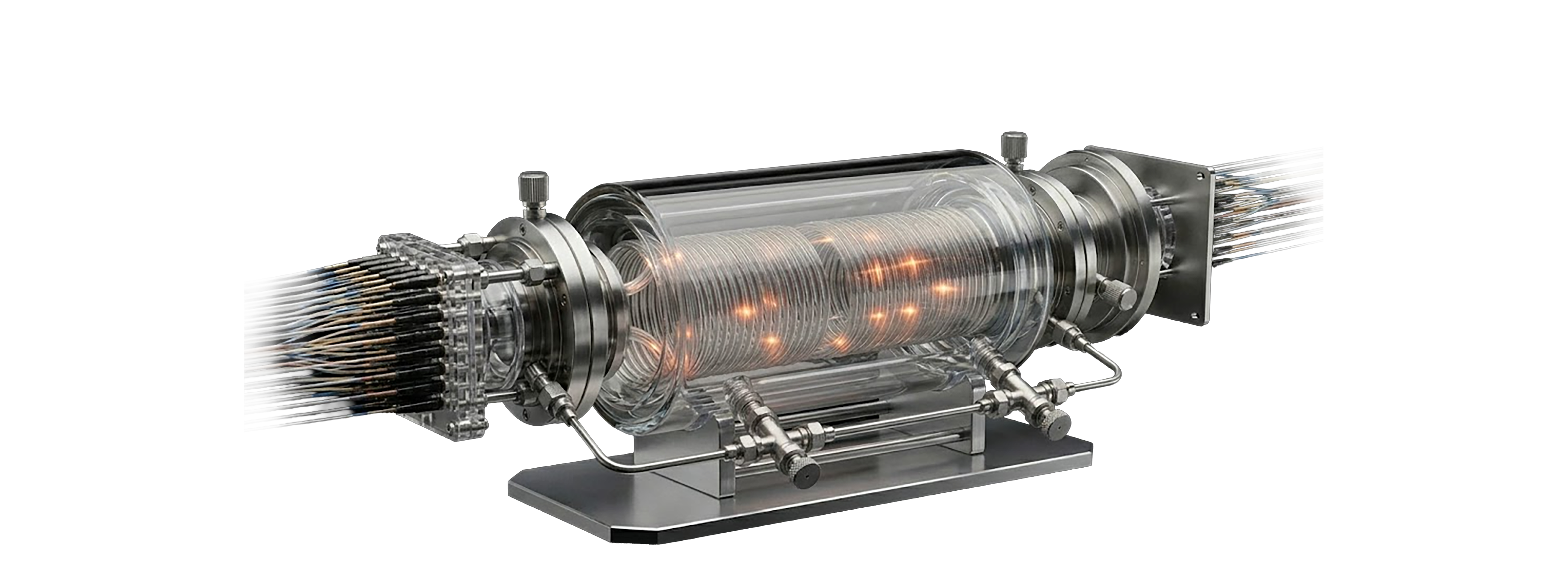
capacity: 5 TB
power draw: 350 W
access time: 49 μs
fiber length: 10 km single-mode
condition: unprecedented
bandwidth: 3.35 TB/s
cooling: "optional"
type: optical delay-line
Every year, the AI infrastructure industry spends roughly $80 billion on memory. It buys chips etched in factories that cost $20 billion to build, ships them in racks that need their own weather systems to stay cool, and plugs them into clusters so large they have their own zip codes. And after all of it — the fabs, the liquid cooling, the power plants, the earnings calls — it still does not have enough room to think.
The machines wait. Sixty to eighty percent of the time, the most expensive processors ever manufactured sit idle. Not broken. Not slow. Starving. Waiting for data that cannot physically arrive fast enough from memory that cannot physically hold enough. Every GPU cluster on Earth runs at roughly a third of its paid capacity — not because the compute is wrong, but because the memory architecture underneath it was designed for a problem one-thousandth this size.
That is not a technical complaint. That is a $195 billion annual inefficiency. It is the difference between what the industry pays for and what the industry gets. The global AI accelerator market will exceed $300 billion by 2028. There are currently zero companies shipping a solution at this scale.
The question the industry keeps asking is: how do we make chips faster?
The right question is: what if the problem was never the chip?
The right question is: what if the problem was never the chip?
· · ·
The Vessel is ten kilometers of Corning single-mode fiber-optic cable, wound into a coil that fits in three rack units. Light enters one end. Light circulates. Data persists in the transit. That is the entire product. No transistors. No semiconductor fab. No supply chain that runs through three countries and two geopolitical flashpoints. Glass and light. Commodity substrate, non-obvious architecture.
It requires no refresh cycles. It generates so little heat that the word "cooling" appears in its spec sheet inside quotation marks, as a courtesy. Corning has been manufacturing this fiber correctly since 1970. They have not needed to revise their position. The physics were settled in 1865 by James Clerk Maxwell, who published four equations describing how light moves through the universe. They have been correct every day since. The Vessel is those equations in a box.
Delay-line memory was invented in 1949 — mercury columns, magnetostrictive wire, quartz crystal. It worked. It was elegant. It was replaced by silicon because silicon got cheap enough to win. Silicon is no longer cheap enough to win at this scale. That is not an opinion. It is arithmetic. Capacity scales linearly by adding more fiber — no lithographic complexity, no billion-dollar fab expansion, no eighteen-month lead time on EUV optics.
· · ·
Here is what the industry built instead of this. To hold 5TB in GPU memory today, you need thirty-six of the most expensive chips on the market. That is $1.4 million in silicon alone — before a single server, rack, switch, or cooling unit. Then you run them at roughly 700 watts each. That is 25 kilowatts of power draw to hold data that is not even computing. You have spent more than a million dollars and built a small power station, and your model has not yet thought a single thought.
── the current path ──────────────────────────
36 GPUs to hold 5TB. $1.4M in chips alone.
~25,000 watts. Before compute. Just to hold data.
Energy per GB: 8.75 watts
Effective compute utilization: ~35%
── the vessel ────────────────────────────────
1 device. 3 rack units. 1 power cable.
350 watts. Total.
Energy per GB: 0.07 watts
125× more efficient per gigabyte. At lower total cost.
── the compute multiplier ────────────────────
A $10M GPU cluster starts producing $28M worth of inference.
Not new compute. The same compute, finally fed.
That multiplier compounds across every processor in the rack,
every rack in the data center, every data center on Earth
trying to serve a model too large to fit in anything
that currently exists.
── the market ────────────────────────────────
AI memory infrastructure spend: $80B/year
Total accelerator market by 2028: $300B+
Annual waste from the memory wall: ~$195B
Utilization unlocked by solving it: ~2.8×
Companies shipping this at scale: 0
This company's ask: $1M for 1%
The Vessel does not replace the cluster. It feeds the cluster. The processors stop starving. The GPUs you already own begin, for the first time, to do the job you bought them for. Every data center that deploys this recovers capacity it already paid for. That is not a product sale. That is an unlock on existing capital expenditure — the kind of value proposition that does not require a customer to spend more, only to stop wasting what they already spent.
· · ·
The semiconductor industry is an engineering moat. It takes $20 billion and five years to build a new fab. But it is an engineering moat — talent, capital, and time can cross it. Intel proved this. TSMC proved it again. Samsung proved it a third time.
The Vessel is a physics moat. The speed of light in glass is not a trade secret. It is a constant. You cannot engineer around a constant, iterate past it, or acquire the company that discovered it. The substrate is commodity Corning fiber — anyone can buy it. The architecture is not commodity. The knowledge of how to turn ten kilometers of fiber into five terabytes of working memory at forty-nine microseconds of latency is the work. That work is done.
You could put this device in a crate, ship it to a salt mine, leave it for a thousand years, dig it up, and plug it back in. It would work. That is Corning glass. That is light, holding your data in the time it takes to cross a city. The cable, uncoiled, is the length of a city.
This device will outlive your servers. It will outlive your server vendor. It will outlive the supply chain your server vendor depends on. The only roadmap it follows was published in Edinburgh, in 1865, and it has not required an update. No export controls apply to glass. No tariff schedule covers photons.
capacity = bandwidth × delay = 3.35 TB/s × 49 μs = 5 TB. That equation requires no earnings call. Just glass, light, and ten kilometers of patience.
· · ·
One percent of the company that solves the memory wall for AI infrastructure is listed here at one million dollars. That is the valuation we assigned ourselves based on the physics, the working prototype, and the size of the problem. We did not hire a bank. We ran the numbers. The numbers are above.
The Neuromorphic Photonics Lab at Queen's University has been right about optical memory architectures for longer than most AI companies have been incorporated. John Carmack has spent thirty years making the case that latency is the only number that matters. Forty-nine microseconds. We read it. We agreed. We built it.
This is not the memory your procurement team expected. It is not the deal your associates are trained to pattern-match. It is not what your GPU vendor wants you to fund. It is a coil of glass, a beam of light, and the oldest correct physics in the building. It is one percent of the company that changes the geometry of a $300 billion market with zero current solutions.
The fucking Vessel.
5TB. 350W. 49 microseconds. $1,000,000 for 1%.
O.B.O. stands for Only Buying Opportunity.
Physics does not negotiate. Neither do we.
- do NOT contact me with memory roadmap slides
- do NOT contact me if your solution involves buying more GPUs
- do NOT contact me if you think the problem is almost solved
- do NOT contact me if you need to check with your IC before reading a Craigslist ad
- do NOT contact me with unsolicited services or offers
- this post was made by the ARC Institute of Knowware
- posting id: FOURIER-001 — posted: 2026-05-04 — updated: now
10,000 m of fiber
◎
Location: your rack
Footprint: 3U
Latency: physics-limited
Footprint: 3U
Latency: physics-limited